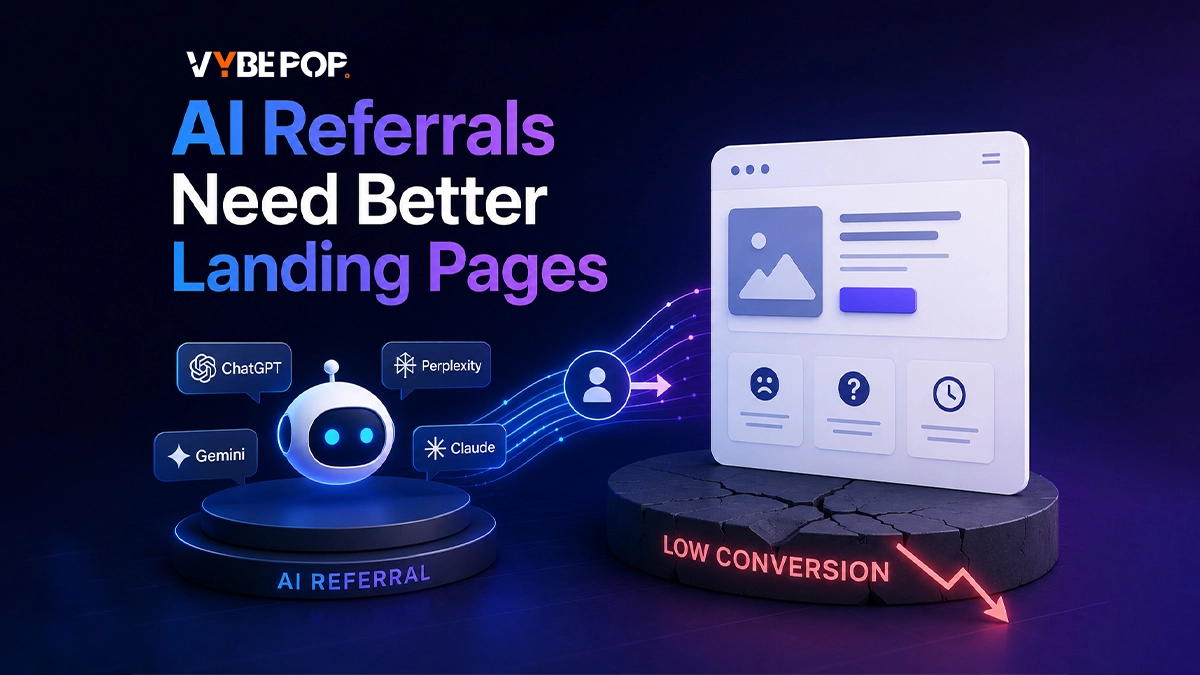
AI referrals are creating a familiar conversion problem: the page AI recommends is often not the page visitors land on.
AI tools may cite a detailed product, service, or article page as evidence. But when users click through, many are sent to the website’s homepage instead. This creates a mismatch between what the visitor expected to see and what they actually see.
That matters because AI-referred visitors are often already interested in the brand. The AI has done much of the research, comparison, and recommendation before the visitor reaches the website. Sending them to a generic homepage can make that momentum disappear.
AI Reads Deep Pages, But Visitors Often Land on the Homepage
Several datasets point to the same pattern.
Similarweb’s 2026 Generative AI Landscape report found that 65% of URLs cited by ChatGPT are two or three folders deep within a website. However, 58.8% of ChatGPT referral traffic lands on homepages.
Previsible found a similar issue after analyzing 6.77 million AI-referred sessions across 166 websites. Its data showed that 28.8% of ChatGPT referrals landed on internal search results pages.
Ahrefs has also reported that more than 80% of its AI referral traffic reaches its homepage, product pages, and free tools instead of its larger collection of editorial content.
These studies use different datasets and methods, so their numbers should not be treated as directly comparable. But they point toward the same broader trend:
AI systems find specific pages. Users are often sent somewhere else.
Why This Can Hurt Conversions
This is not a completely new conversion problem.
Traditional conversion optimization has long focused on matching the landing page with the visitor's intent. Someone clicking on a specific product should ideally see that product, not a generic page asking them to start their search again.
AI referrals create a similar challenge.
A chatbot may recommend a specific service page because it answers the user's question. But if the referral takes that person to the homepage, they have to find that service again.
That adds friction at exactly the point where the visitor may be ready to act.
AI-Referred Visitors Can Be More Valuable
People from AI systems could have already reached a later stage in their decision-making process.
A chatbot may have already helped to uncover the information, find the right product, and even understand it on a chat level. So that, when they clicked through, they could be expecting confirmation cost detailed explanation of the item, or the next action to take.
Studies have found that people who get a recommendation from ChatGPT are more likely to go to the brand's website after that. So the goal should not simply be to attract AI referrals.
The goal is to make sure those referrals arrive at a page that matches the reason they clicked.
If AI is using your deep pages to build trust, your website needs to preserve that context when the user arrives. Otherwise, the AI may do the selling while your homepage makes the visitor start over. To stay updated, get in touch with Vybepop Media.